Article: Hair porosity: how to test it and understand your hair type
Hair porosity: how to test it and understand your hair type
Ever wonder why a conditioner leaves your friend's hair silky but makes yours feel heavy? The answer might be hair porosity, one of the most important characteristics influencing how your hair absorbs water, retains moisture, and responds to products.
Maybe your hair takes forever to get completely wet. Or perhaps it dries surprisingly fast, yet still feels rough by the afternoon. These little details can tell you more about your hair than its appearance alone.
Understanding your hair starts with three characteristics: porosity, texture and density. Each describes something different, and together, they help explain why certain routines feel effortless while others never quite deliver the results you expect.
What is hair porosity and why does it matter?

Hair porosity describes how readily your hair absorbs and releases water. It influences how moisture interacts with your strands and can help you understand why some conditioning products feel comfortable while others seem to sit on the surface.
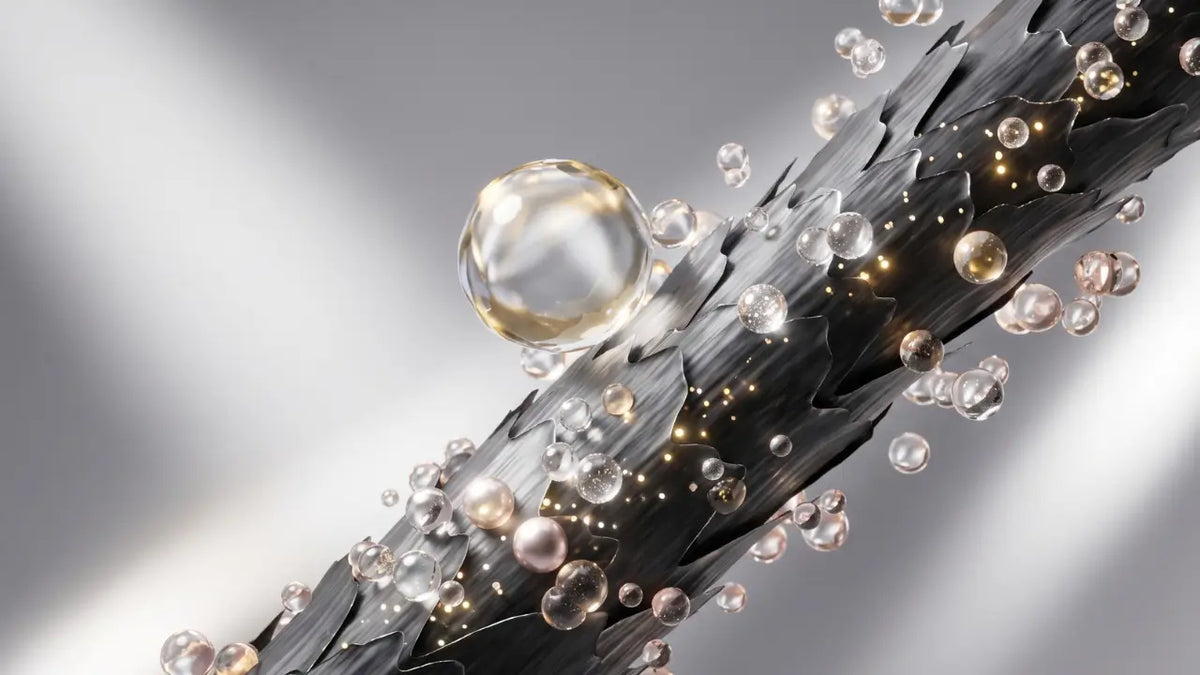
Every strand has an outer protective layer called the cuticle. Think of it as a series of tiny, overlapping scales that protect the inner structure of your hair.
The condition of this layer affects how your hair interacts with water, conditioning ingredients, humidity, and everyday styling.
Hair porosity is commonly described in three categories.
Low-porosity hair
Low-porosity hair generally has a relatively compact, intact cuticle that can make wetting the hair more difficult.
You might notice that:
-
Water initially beads on your strands.
-
Your hair takes longer to become fully saturated.
-
Creams and oils can leave a noticeable coating.
-
Your hair feels heavy after applying rich conditioners.
low-porosity doesn't automatically mean your hair lacks moisture. Sometimes, the greater challenge is finding products that condition effectively without leaving unnecessary buildup.
Medium-porosity hair
Medium-porosity hair is often described as having a relatively balanced response to wetting, conditioning, and moisture retention.
Your hair may:
-
Become wet without much difficulty.
-
Feel soft after regular conditioning.
-
Respond comfortably to different styling products.
-
Maintain manageable texture between washes.
This doesn't mean your hair never experiences dryness or frizz. Weather, heat styling, coloring, and product buildup can still influence how it feels.
High-porosity hair
High-porosity hair often has a more weathered or damaged cuticle, allowing water to move through the fiber differently.
Common signs include:
-
Hair that becomes wet relatively quickly.
-
Roughness or tangling, especially at the ends.
-
Frizz that returns shortly after styling.
-
Greater sensitivity to humidity.
-
Increased dryness following chemical treatments or frequent heat styling.
High-porosity can be associated with natural hair characteristics, but bleaching, chemical processing, and accumulated damage can also increase it.
Porosity isn't necessarily identical throughout your hair. Your ends, for example, may be more porous than the newer growth near your roots.
Hair texture types: understanding your natural pattern
When you ask yourself 'what is my hair type?' Texture is often the first characteristic you notice.
Hair texture describes the natural shape or pattern your strands form. Unlike porosity, it doesn't directly describe how readily water enters or leaves the hair fiber.
The main hair texture types include:
-
Straight hair: Falls without a clearly defined wave or curl pattern.
-
Wavy hair: Forms gentle bends or more noticeable S-shaped waves.
-
Curly hair: Develops defined spirals or ringlets.
-
Coily hair: Forms tight curls, coils, or compact bends.
A hair typing system can help describe these visible patterns, but it doesn't tell the whole story of how your hair behaves.
You can have curly hair with low-porosity or straight hair with high porosity. Texture alone doesn't determine your moisture needs.
Texture is particularly helpful when choosing styling techniques. Porosity becomes more relevant when evaluating how your hair responds to water and conditioning.
Both matter, but they answer different questions.
Hair density chart: how much hair do you have?

Density describes the number of individual hair strands growing within a given area of your scalp.
It's another important characteristic when learning how to know your hair type, especially if you're trying to understand your hair's natural volume and fullness.
A simple hair density chart organizes hair into three general categories:
|
Density |
What you may notice |
|
Low |
Your scalp is relatively easy to see when your hair is loose. |
|
Medium |
Some scalp may be visible when you part or move your hair. |
|
High |
Your scalp is less visible without deliberately separating sections. |
How to check hair density at home
You don't need specialized equipment for a basic visual assessment.
Start with clean, dry hair in its natural position. Stand in front of a mirror under consistent lighting.
Gently separate your hair near the crown and observe how easily you can see your scalp.
Repeat the observation in a few areas to develop a more complete impression.
This isn't an exact strand count. Lighting, hair color, styling, and texture can all affect how visible your scalp appears.
Density helps guide styling decisions, particularly when you're considering volume and product application.
Porosity, meanwhile, tells you something different about how the strands themselves behave.
How to know your hair porosity at home
If you've searched for how to know your hair porosity, you've probably encountered the popular water glass method.
It's easy to understand, requires almost no preparation, and has become a familiar part of online hair care advice.
However, there's an important distinction: the water glass test is a popular experiment, not a scientifically reliable measurement of hair porosity.
Here's how it works and what its results can, and cannot, tell you.
The water glass hair porosity test
The traditional hair porosity test method uses a single strand and a glass of water.
Step 1: Start with a clean strand
Select a naturally shed hair strand, ideally without visible styling product residue.
Step 2: Fill a glass with water
Use a transparent glass filled with room-temperature water. Gently place the strand on the surface without pushing it underwater.
Step 3: Observe for a few minutes
Watch whether the strand remains on the surface, becomes suspended, or sinks toward the bottom.
Traditional interpretations suggest that floating indicates low-porosity, sinking indicates high porosity, and remaining suspended indicates medium porosity.
The water glass test can be interesting, but it shouldn't determine your entire hair care routine. After all, water's surface tension, natural oils, product residue, and the strand's physical characteristics can also influence whether it floats or sinks.
That's why it's helpful to consider this observation alongside how your hair behaves in everyday life, especially during washing, conditioning, and styling.
A more useful way to understand your porosity
Rather than relying on a single experiment, pay attention to how your hair behaves over several wash days.
Consider these questions:
-
Does water spread through your hair easily during washing?
-
Do conditioning products leave your strands soft or coated?
-
Does your hair become rough shortly after drying?
-
Are your ends noticeably drier than your roots?
-
Has your hair changed following coloring or heat styling?
These observations aren't a precise diagnosis either. However, repeated patterns can offer practical clues about your hair's condition and product preferences.
Building a hair care routine based on porosity

Once you understand your texture, density, and likely porosity, choosing products becomes more intentional.
The goal isn't to follow a rigid formula. It's to find the balance of cleansing, conditioning, and styling that makes your hair feel comfortable and manageable.
Low-porosity hair routine
A low-porosity hair routine often benefits from lightweight, easy-to-distribute formulas.
Try focusing on:
-
Gentle cleansing to remove accumulated residue.
-
Lightweight conditioners applied mainly to the midlengths and ends.
-
Small amounts of leave-in products.
-
Thorough rinsing when products leave your hair feeling coated.
Warm water can help make washing more comfortable, but excessive heat isn't necessary for conditioning.
The objective is softness and movement without unnecessary weight.
Medium-porosity hair routine
Medium-porosity hair may respond well to a balanced routine combining regular cleansing and conditioning.
Focus on maintaining comfortable softness, protecting your strands during heat styling, and adjusting your products when environmental conditions change.
If your hair starts feeling heavy, you may need less product. If it feels rough, additional conditioning may help.
High-porosity hair routine
High-porosity hair may benefit from more consistent conditioning, especially when chemical treatments or heat damage have affected the cuticle.
Consider:
-
Conditioning products that improve softness and manageability.
-
Leave-in treatments to reduce friction during styling.
-
Formulas that help smooth the hair's surface.
-
Gentle detangling and reduced exposure to excessive heat.
Conditioning can improve how damaged hair feels and behaves, although it cannot permanently restore severely damaged cuticles.
The right cleanser matters across all three categories. Different shampoo formulas address needs such as hydration, smoothing, and volume. Your scalp condition and hair goals are also important considerations when choosing the right formula.
What your hair type tells you about choosing products
Now that the three characteristics are clearer, you can connect what you've learned to the results you want.
Texture helps you understand your natural pattern and styling needs.
Density adds context to fullness, volume, and how you distribute products.
Porosity helps explain your hair's interaction with water and why certain conditioning approaches may work better than others.
Together, these characteristics provide a more complete picture than any single classification.
For example, you might have high-density, wavy hair with relatively low-porosity. A lightweight routine could support movement without making your waves feel coated.
Someone with coily, high-porosity hair might prioritize conditioning, gentle detangling, and reducing moisture-related roughness.
Once you've identified these needs, the Hair by Goal guide offers a useful way to connect your observations with specific priorities, including moisture, smoothness, repair, and volume.
This approach shifts the focus from fitting your hair into a category to understanding what it actually needs.
Your hair is more than a single type
Your hair doesn't need to fit perfectly into one classification. Its behavior can change with chemical treatments, environmental exposure, styling habits, and the condition of individual strands.
What matters most is recognizing patterns: how easily your hair becomes wet, how it feels after conditioning, and which formulas leave it soft, light, and manageable.
Understanding hair porosity, alongside texture and density, gives you a more thoughtful foundation for everyday hair care. Instead of relying on one test or label, you can build a routine around how your hair genuinely responds.

Written by Stephen Knoll